
Your company pays for health insurance. Your employees are afraid to use it. What’s wrong with this picture?
Every year, employers write one of the largest checks in the business for health coverage. It’s a serious investment, made in good faith, to take care of people.
Then something quiet happens. The people it was meant to help start avoiding it.
Covered, but hesitant
Ask employees why they put off seeing a doctor and the answers are remarkably consistent.
- High deductibles. The first few thousand dollars of care come out of their own pocket, so a visit feels like a bill waiting to happen.
- Surprise bills. An unexpected charge after a visit teaches people not to go back.
- Weeks waiting for an appointment. By the time the slot arrives, the problem has either faded or grown.
None of this means the insurance is bad. It means the insurance was built for big, rare events, and everyday care has to fit through a door that’s expensive to open and slow to walk through.
What good is health insurance if employees hesitate to seek care?
What the hesitation costs
When people delay care, the cost doesn’t disappear. It moves.
A sinus infection becomes a week of low productivity. An anxious stretch becomes missed shifts. A prescription that lapsed becomes an urgent care visit on a Saturday. Managers feel it as absence and distraction. Employees feel it as stress. Finance eventually feels it in the claims that could have been small and weren’t.
The employer paid for coverage and got the problem anyway.
Change the approach, not the carrier
The instinct is to fix this with another plan design conversation: a new carrier, a different network, a broker shuffle. Those are large, slow changes, and they don’t touch the real issue, which is that getting everyday care is hard.
There’s a simpler move. Keep the coverage exactly as it is and add access on top of it.
- No carrier change. Your medical plan stays in place.
- No broker change. Your advisor relationship is untouched.
- No claims charged back. Visits don’t run through the plan, so they don’t show up in your claims experience.
What access looks like
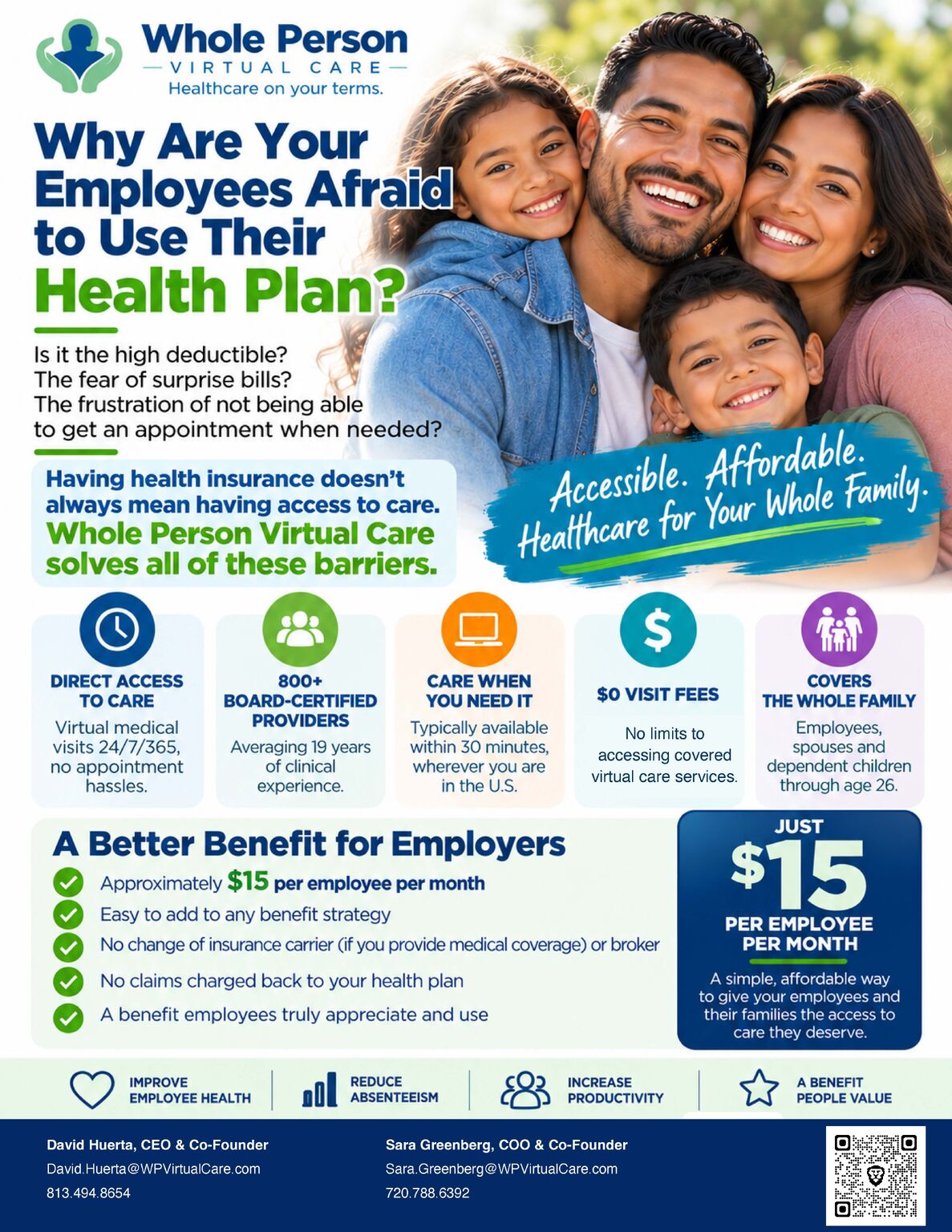
Whole Person Virtual Care is a professional medical service, not insurance, so it sits alongside any plan, or none at all. For employees and their families, it means:
- A real provider in about 30 minutes, from any device, day, night or weekend.
- A $0 visit fee and no limit on the number of visits, so cost never becomes the reason to wait.
- Providers who can diagnose, treat, prescribe, authorize refills and order labs when medically appropriate, across acute and urgent care, family care, mental healthcare and weight management.
- Coverage for the employee, spouse and eligible dependents through age 26.
The difference shows up in behavior. When the visit is fast and free, people stop rationing care. Small problems get handled while they’re still small, and “I can’t afford to use my benefits” stops being a reason anyone delays.
Coverage is the promise. Access is the delivery.
Insurance tells your employees they’re protected. Access lets them act on it. One without the other leaves money on the table and people at home, waiting.
It’s time to turn “you’re covered” into “you can get care.”
Adapted from a LinkedIn post by David Huerta, CEO and Co-Founder of Whole Person Virtual Care.


